Viniferin Forms Compared: Structural Identity, Nomenclature, and Analytical Relevance for Research Procurement
A chemistry-first comparison of resveratrol oligomers from epsilon-viniferin through vitisin A and vitisin B. Covers oligomer classification, naming conventions, stereochemical considerations, the pyranoanthocyanin naming collision, and what matters for analytical procurement.
Resveratrol is one of the most studied natural products of the past three decades. It is a small stilbenoid monomer, first isolated from the roots of white hellebore (Veratrum grandiflorum) in 1939 by Takaoka and later identified as a phytoalexin produced by grapevines under pathogenic stress. The compound drew widespread attention after early reports linked it to cardiovascular and anti-aging effects in animal models, and it remains one of the most commercially available plant polyphenols in the world.
What receives far less attention, however, is what resveratrol does inside a living plant after it is produced. Under oxidative conditions, resveratrol monomers can undergo regioselective oxidative coupling to form a structurally diverse family of oligomers: dimers, trimers, tetramers, and, in some plant families, still larger oligostilbenes. These compounds matter analytically because the family name is broad while the structures are specific.
The viniferins are a historically named subset of this oligomer family. The naming system is useful enough to appear in literature searches and procurement records, but not clean enough to stand on its own. Greek-letter prefixes such as ε, δ, and α do not map neatly onto oligomer size, stereochemistry, or biosynthetic sequence. For a laboratory evaluating a reference material, the practical question is not “which viniferin is this?” It is “which exact oligomer, with which structure, stereochemical context, and identity package, is this record referring to?”
Resveratrol: The Monomeric Starting Point
Resveratrol (trans-3,5,4′-trihydroxystilbene, CAS 501-36-0) is biosynthesized through the phenylpropanoid pathway. Stilbene synthase condenses one molecule of 4-coumaroyl-CoA with three molecules of malonyl-CoA to produce the stilbene backbone. The trans isomer is the predominant naturally occurring form; the cis isomer can arise by photoisomerization and has its own analytical importance in stability work.
What matters for this article is that resveratrol is the common starting unit for the viniferin family. Oxidative coupling between monomers produces dimers such as ε-viniferin. Further coupling of dimers and monomers produces trimers such as α-viniferin, and dimer-plus-dimer chemistry can generate tetramers such as vitisin A and vitisin B. In other words, the family is best understood as a branching resveratrol-oligomer ladder rather than a simple alphabetical series.[1][2]
The Viniferin Naming Problem
The Greek-letter system was established historically as individual compounds were isolated and characterized. It was not built as a modern, structure-first taxonomy.
That creates three practical problems:
- The letters do not indicate oligomer size.
ε-viniferinis a dimer, whileα-viniferinis a trimer.[1][2] - The letters do not consistently indicate stereochemistry. Dimeric viniferins can carry multiple stereochemical variants, and the Greek letter alone does not tell you which one is under discussion.[3][4]
- Some names are more stable than others.
ε-viniferin,δ-viniferin,α-viniferin,vitisin A, andvitisin Bare useful anchors.ω-viniferinis better treated as a secondary nomenclature note, andβ-viniferinis too inconsistent to serve as a strong public anchor.[2][4]
For procurement or analytical work, the right habit is to treat the family name as a literature guide and the compound-specific identity package as the real decision surface.
Major Viniferin Forms at a Glance
| Compound | Oligomer class | Formula | Practical note |
|----------|----------------|---------|----------------|
| ε-Viniferin | Dimer | C₂₈H₂₂O₆ | Best-known dimeric viniferin anchor |
| δ-Viniferin | Dimer | C₂₈H₂₂O₆ | Isomeric/dehydrodimeric comparator to ε-viniferin |
| α-Viniferin | Trimer | C₄₂H₃₀O₉ | Trimeric branch of the family |
| Vitisin A | Tetramer | C₅₆H₄₂O₁₂ | Often mapped to R2-viniferin |
| Vitisin B | Tetramer | C₅₆H₄₂O₁₂ | Often mapped to R-viniferin; not interchangeable with vitisin A |
Epsilon-Viniferin: The Dimeric Anchor
ε-Viniferin (CAS 62218-08-0, C₂₈H₂₂O₆, MW 454.47 g/mol) is the most practical entry point into the family. It is widely treated as a resveratrol dimer and often functions as the structural anchor from which higher oligomers are discussed.[1][2] It is especially useful on a comparison page because it is small enough to be conceptually clear while still showing the viniferin-type dihydrobenzofuran framework.
Published work has also made clear that stereochemistry matters. Chiral analytical studies on E-ε-viniferin show that enantiomeric form is part of the real identity story, not merely an abstract naming issue.[3] That makes ε-viniferin a good illustration of why “viniferin” alone is not enough for precise laboratory use.
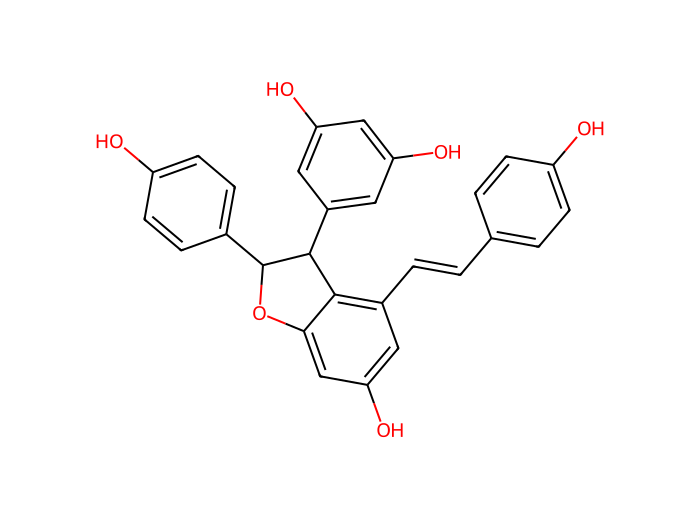
2D structure of ε-viniferin (CAS 62218-08-0), the canonical resveratrol dimer and the clearest entry point into the viniferin family.
Delta-Viniferin: The Dimeric Comparator
δ-Viniferin is the most useful side-by-side comparator to ε-viniferin because it makes the naming problem visible immediately. It shares the same molecular formula as ε-viniferin but is discussed in the literature as a distinct isomeric/dehydrodimeric outcome of oxidative resveratrol coupling.[5]
For a buyer or analyst, the important point is simple: two compounds can both be “viniferin” dimers and still not be interchangeable. That is why a chemistry-first catalog should pair the family name with structural imagery, formula, and verified identifiers rather than assuming the common name does enough work by itself.
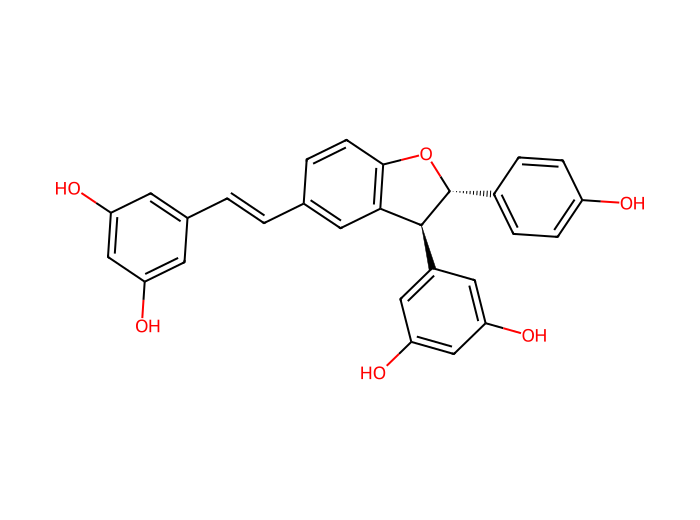
2D structure of δ-viniferin, included to show that even within the dimeric viniferins, names are not interchangeable placeholders.
Alpha-Viniferin: The Trimeric Step
α-Viniferin (CAS 62218-13-7, C₄₂H₃₀O₉, MW 678.70 g/mol) is a resveratrol trimer, and that one fact already makes it analytically distinct from ε-viniferin and δ-viniferin.[1][2][6] This is the clearest example of why the Greek-letter system is historically memorable but chemically misleading. The alpha prefix does not mean smaller, simpler, or more primary.
In a comparison article, α-viniferin is valuable because it shows how quickly the family expands beyond the dimeric level. It also helps the page target the common search behavior in which laboratories or procurement teams know the family term but need help understanding why the listed compounds should be treated as distinct.
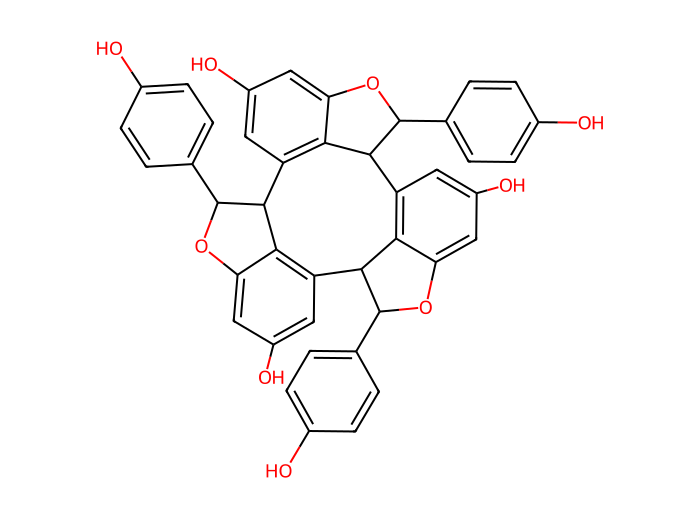
2D structure of α-viniferin (CAS 62218-13-7), representing the trimeric branch of the viniferin discussion.
Vitisin A and Vitisin B: The Tetrameric Compounds
The tetrameric branch is where the family becomes most structurally rich and most vulnerable to naming drift.
Vitisin A
Vitisin A (CAS 142449-89-6, C₅₆H₄₂O₁₂, MW 906.93 g/mol) is a resveratrol tetramer often mapped in the literature to R2-viniferin.[1][7] It is best treated as a higher-order resveratrol oligomer within the broader viniferin conversation, not as a minor variant of the dimeric compounds.
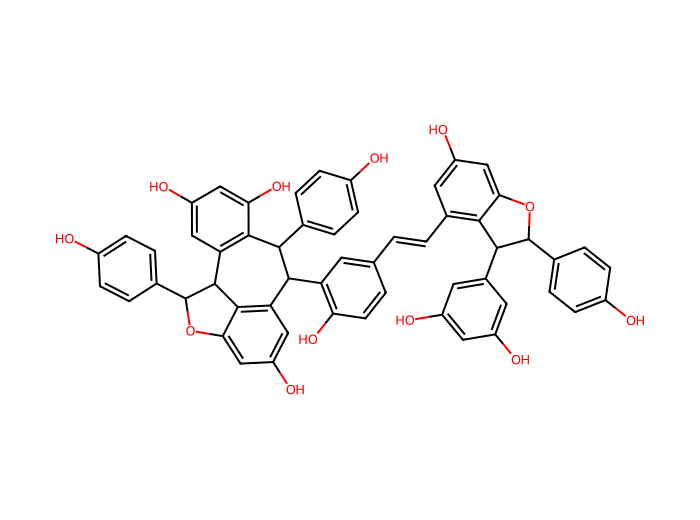
2D structure of vitisin A, a tetrameric resveratrol oligomer often discussed as part of the wider viniferin family.
Vitisin B
Vitisin B (CAS 142449-90-9, C₅₆H₄₂O₁₂, MW 906.92 g/mol) is the second major tetramer and is often mapped to R-viniferin.[1][7][8] It shares the same molecular formula as vitisin A but is not the same structure. That alone makes it a useful procurement example: molecular formula matching does not eliminate the need for structural specificity.
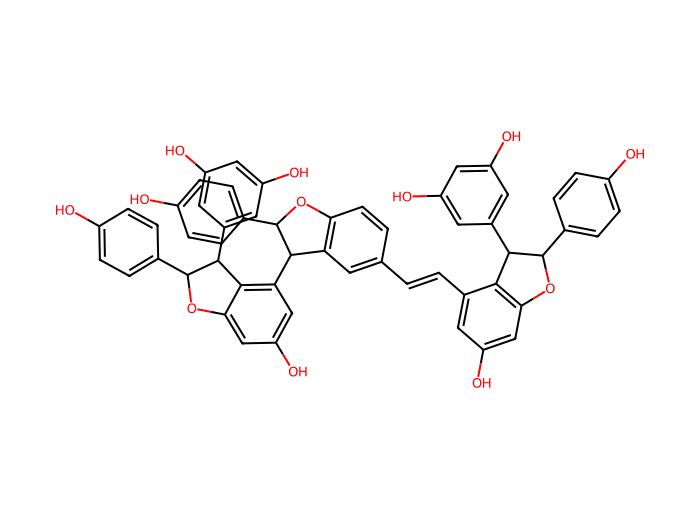
2D structure of vitisin B, a distinct tetramer rather than a synonym for vitisin A.
The Vitisin Naming Collision
One of the most important cautions in this space is that vitisin A and vitisin B can also refer to unrelated pyranoanthocyanin wine pigments. Those compounds belong to a different chemical class entirely. A search for vitisin B can therefore mix stilbenoid tetramers with wine-pigment literature unless the query is constrained by compound class or CAS number.[8][9]
That naming collision is not just an academic footnote. It matters for search, indexing, and procurement clarity. If a supplier or buyer does not specify that the record is a stilbenoid tetramer, confusion becomes easy.
Omega-Viniferin and Beta-Viniferin
ω-Viniferin appears in the literature as a stereochemically distinct viniferin-type dimer, but it is not as stable a public anchor as ε-viniferin or δ-viniferin.[2][4] β-Viniferin is even less reliable as a public-facing chemistry term because literature sources do not use it consistently enough to make it a strong catalog pillar.
That does not mean these names are useless. It means they are better handled as nomenclature caution points rather than as the center of the first family-comparison article.
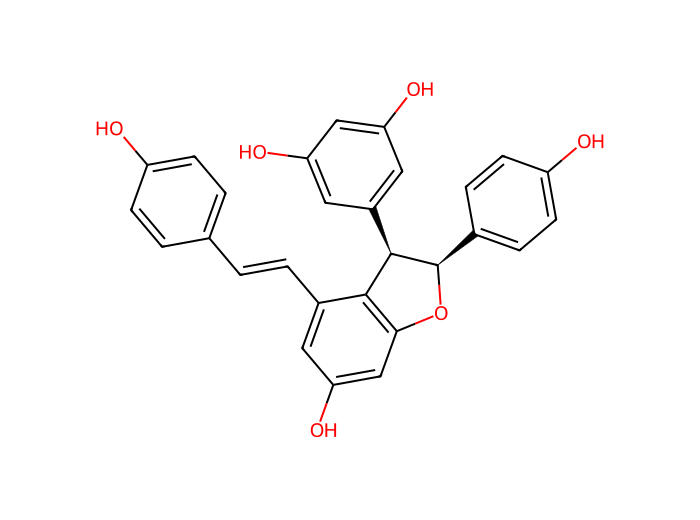
2D structure of ω-viniferin, included as a nomenclature note rather than as a primary family anchor.
What Matters for Analytical Procurement
For a laboratory comparing viniferin-family reference standards, the minimum useful identity package includes:
- exact compound name plus verified CAS number
- oligomer class
- molecular formula and molecular weight
- structure image consistency
- stereochemical context where known
- documented purity and analytical method
- COA and SDS availability
- explicit RUO labeling
That is the real analytical lesson of the family. The Greek letter may help a researcher find the literature, but it should not be the only thing they rely on when evaluating a material.
Frequently Asked Questions
Is alpha-viniferin the same as epsilon-viniferin?
No. α-Viniferin is generally treated as a resveratrol trimer, while ε-viniferin is treated as a resveratrol dimer.[1][2][6]
Are vitisin A and vitisin B the same compound?
No. They are distinct tetrameric resveratrol oligomers with the same molecular formula but different structures.[1][7][8]
Why are viniferin names confusing?
Because the Greek-letter naming system developed historically and does not function like a clean modern structural taxonomy. It spans multiple oligomer sizes and does not reliably encode stereochemical detail.[1][2]
What should a laboratory check first when comparing viniferin records?
Start with the oligomer class, verified CAS number, formula, and documentation posture. The family name alone is not enough.
References
- Rivière C, Pawlus AD, Mérillon JM. Natural stilbenoids: distribution in the plant kingdom and chemotaxonomic interest in Vitaceae. Nat Prod Rep. 2012. RSC article
- Keylor MH, Matsuura BS, Stephenson CRJ. Chemistry and Biology of Resveratrol-Derived Natural Products. Chem Rev. 2015. ACS article
- Trapp O, Besselmann C, et al. Chiral analysis of
E-ε-viniferinenantiomers. 2023. PubMed - Ficarra A, Lo Presti M, et al. Enantiomeric and stereochemical studies on viniferin-type dimers. 2016. PubMed
- Pezet R, Pont V, Hoang-Van K. δ-Viniferin, a resveratrol dehydrodimer: one of the major stilbenes synthesized by stressed grapevine leaves. J Agric Food Chem. 2003. PubMed
- Kim HJ, Chang EJ, Bae SJ, et al.
α-Viniferinin the literature as a trimeric stilbenoid context. PubMed - Waffo-Téguo P, et al. Stilbene oligomer screening and vitisin naming context. 2020. PMC
- Keylor MH, et al. Tetrameric resveratrol-oligomer context including vitisins. PubMed
- UC Davis Waterhouse Lab. Pyranoanthocyanins overview. Link