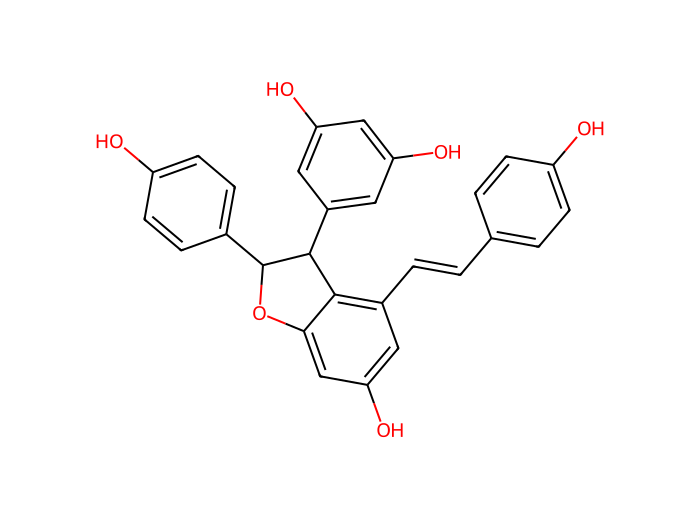
CAS Number
62218-08-0
Molecular Formula
C28H22O6
Molecular Weight
454.5
Purity
≥ 98% (HPLC)
Appearance
Solid
Storage
Store at -20°C, dark and dry.
What Is epsilon-Viniferin?
epsilon-Viniferin (CAS 62218-08-0) is a resveratrol dimer and phytoalexin first isolated from grapevine in 1977. Structure, biosynthesis, natural occurrence, and analytical sourcing notes.
epsilon-Viniferin (CAS 62218-08-0) is a resveratrol dimer first isolated from grapevine in 1977. It belongs to the stilbenoid oligomer family and occurs naturally as a phytoalexin — an antimicrobial compound produced by plants in response to stress or infection.
For analytical laboratories, epsilon-viniferin is a structurally defined reference material. The viniferin family spans dimers through tetramers with multiple regioisomeric coupling modes; epsilon-viniferin is the 8-10′ coupled dimer that serves as the biosynthetic entry point to a majority of higher-order oligostilbenes. When a method requires a documented dimeric anchor in the resveratrol series, this is the compound.
Compound identity
| Field | Value |
|---|---|
| CAS Number | 62218-08-0 |
| Molecular formula | C28H22O6 |
| Molecular weight | 454.47 g/mol |
| Compound class | Resveratrol dimer; oligostilbene |
| Oligomer coupling mode | 8-10′ |
| Core scaffold | 2,3-Diaryl-2,3-dihydrobenzofuran |
The 8-10′ coupling distinguishes epsilon-viniferin from the other major resveratrol dimers. δ-Viniferin is the 3-8′ oxidative dehydrodimer; pallidol and quadrangularin A represent the 8-8′ coupling mode. Greek-letter nomenclature is standard in the literature, but the coupling position and stereochemistry — not the name — determine which dimer is present.
Natural sources produce both enantiomers, but the distribution is family-specific. (+)-ε-Viniferin [7a(S), 8a(S)] is the form found in Vitaceae (grapevine); (−)-ε-viniferin [7a(R), 8a(R)] is the form isolated from Dipterocarpaceae, Cyperaceae, and most other families (Kurihara et al., Tetrahedron Lett., 1990, 31, 6527–6530). The cis diastereomer at the same centers is sometimes designated ω-viniferin in the literature.
Discovery and structural basis
Langcake and Pryce isolated epsilon-viniferin from Vitis vinifera and identified it as the first characterized member of a new class of grapevine phytoalexins, which they named the viniferins (Experientia, 1977, 33, 151–152). In a companion communication (J. Chem. Soc., Chem. Commun., 1977, 208–210), they demonstrated that oxidative dimerization of resveratrol in vitro produced the same compound, establishing the biosynthetic link between the monomer and the dimer.
The structure was later refined by spectroscopic and synthetic methods. The 8-10′ regiochemistry creates a 2,3-diaryl-2,3-dihydrobenzofuran core in which one resveratrol unit contributes the benzofuran ring and the other contributes the stilbene side chain. This connectivity is significant because the 8-10′ dihydrobenzofuran motif recurs throughout the higher-order resveratrol oligomers, including the trimers gnetin H and miyabenol C and the tetramer vitisin B.
Biosynthesis
Resveratrol oligomerization proceeds via coupling of oxidatively generated phenoxyl radicals, as originally proposed by Langcake and Pryce. Two resveratrol monomers couple at the C-8 and C-10′ positions to form the dihydrobenzofuran ring of epsilon-viniferin. In 1998, Pezet isolated a laccase-like stilbene oxidase from Botrytis cinerea — the grapevine pathogen itself — that dimerized resveratrol to epsilon-viniferin in 97% yield, confirming that the coupling can proceed enzymatically.
Because the 8-10′ linkage is the most common structural motif among resveratrol-derived natural products, epsilon-viniferin functions as a biosynthetic hub. Higher-order oligomers are assembled not by iterative addition of resveratrol monomers, but by convergent coupling of epsilon-viniferin with resveratrol or with other dimers. Biomimetic cross-coupling experiments using horseradish peroxidase have confirmed these biosynthetic relationships by isolating the expected trimeric products in yields sufficient for structural verification.
Natural occurrence
Epsilon-viniferin was first detected in Vitis vinifera leaves and canes after ultraviolet irradiation or fungal infection, accumulating alongside resveratrol as part of the plant's defense response. It has since been reported in other Vitis species, including V. labrusca cell suspension cultures and V. rotundifolia (muscadine grape) hairy root cultures.
The compound is not restricted to the Vitaceae. Kurihara and co-workers isolated epsilon-viniferin from Carex pumila (Cyperaceae) in 1990 (Agric. Biol. Chem., 54, 1097–1099), and it has been identified in Paeonia lactiflora seeds. In grapevine-derived matrices, epsilon-viniferin typically co-occurs with resveratrol, δ-viniferin, and the higher oligomers alpha-viniferin, vitisin A, and vitisin B.
Documented research context
Epsilon-viniferin has been evaluated in several in vitro antioxidant assays with quantified results:
- DPPH radical scavenging: IC₅₀ ~80 µM (Sy et al., Molecules, 2023, 28, 7521). This is comparable to resveratrol itself (IC₅₀ ~82 µM in the same assay) and falls within the 52–92 µM range reported across three independent studies.
- FRAP (ferric reducing antioxidant power): IC₅₀ ~28.8 µM, approximately double the activity of resveratrol under the same conditions.
- Hydroxyl radical scavenging: trans-epsilon-viniferin significantly inhibited 2-deoxyribose degradation and rat-liver microsomal lipid peroxidation induced by Fenton-type hydroxyl radical generation.
In the analytical literature, epsilon-viniferin is used as a reference compound for HPLC and LC-MS method development in oligostilbene profiling. Its role as the precursor scaffold to higher-order viniferins makes it particularly useful when a chromatographic method must resolve the full oligomer series from monomer through tetramer. Comparative runs including epsilon-viniferin alongside alpha-viniferin, vitisin A, and vitisin B provide family-level retention time mapping that a single-compound standard cannot.
Sourcing
Sylverity supplies epsilon-viniferin (CAS 62218-08-0) as a Research Use Only (RUO) reference standard. Each lot ships with HPLC purity data and a Certificate of Analysis. Safety Data Sheet (SDS) is available on request.
Materials are for laboratory and analytical applications only. Not for human consumption, therapeutic use, or consumer resale.
For lot-specific documentation, quantity, or custom analytical requirements, contact the laboratory directly.
Related Compounds
alpha-Viniferin
CAS 62218-13-7
Vitisin A
CAS 142449-89-6
Vitisin B
CAS 142449-90-9
delta-Viniferin
CAS 71126-73-5
trans-Resveratrol
CAS 501-36-0