What Is epsilon-Viniferin? A Research-Facing Chemistry Overview
A chemistry-first overview of epsilon-viniferin covering compound class, CAS identity, analytical relevance, research applications, and why structure-first supplier records matter.
epsilon-Viniferin (CAS 62218-08-0) is a resveratrol dimer in the broader stilbenoid oligomer family. For research teams, that means it is not simply another polyphenol name in a long list of plant-derived molecules. It is a structurally specific oligomer with analytical relevance when laboratories need a chemistry-defined comparison point for resveratrol-derived natural products.
In supplier language, epsilon-viniferin is most useful as a reference-standard or identity-reviewed research compound. Laboratories may use it when they need a documented material for comparative analysis, method development, or procurement review tied to a precise structure rather than a general class label.
Compound identity
The core identity fields are what make the record usable:
- CAS Number: 62218-08-0
- Oligomer class: resveratrol dimer
- Molecular formula: C28H22O6
- Molecular weight: 454.47 g/mol
Those fields matter because the viniferin family is not cleanly self-explanatory. Greek-letter names are common in the literature, but they do not replace structure-level review. A documented supplier record helps a laboratory verify that the intended dimer is the one actually being sourced.
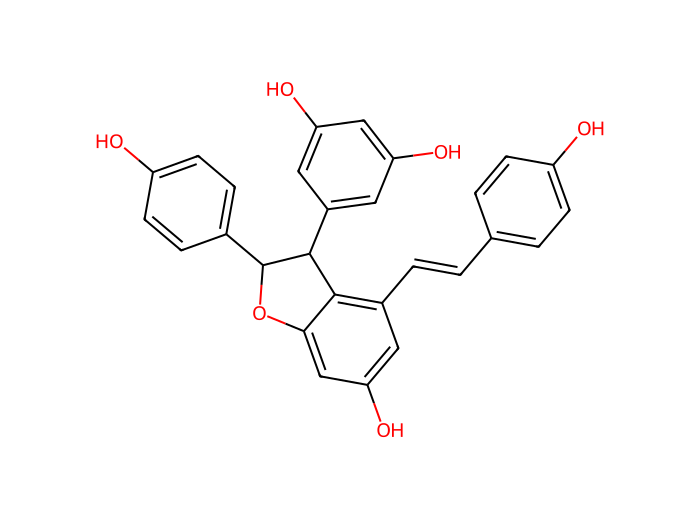
Structure-first presentation helps reduce ambiguity when comparing viniferin-family records.
Why researchers care about epsilon-viniferin
As a dimeric oligostilbene, epsilon-viniferin often appears in discussions of:
- antioxidant and oxidative-stress workflows
- comparative oligomer profiling
- natural-product chemistry
- analytical reference-standard sourcing
For many teams, the real value is not that the compound is famous. It is that the compound is specific. When the goal is to compare a dimer against trimers or tetramers in the same family, or to validate a chromatographic method against a defined oligomer, structure-specific sourcing becomes more important than broad class language.
Research applications
There is no single universal “epsilon-viniferin experiment.” Instead, the compound tends to matter in a few repeatable contexts:
1. Comparative stilbenoid analysis
Teams comparing epsilon-viniferin, alpha-viniferin, vitisin A, and vitisin B need a dimeric anchor in the set. epsilon-Viniferin provides that anchor because it is small enough to be conceptually clear but still belongs to the same family discussion as the higher-order oligomers.
2. Analytical method development
When a laboratory is building or validating an HPLC or LC-MS workflow for oligostilbenes, a documented reference material can be more useful than a loosely described literature name. The supplier record becomes part of the method context.
3. Procurement review
Institutional buyers often need a structure image, CAS number, purity posture, and documentation access before they can route a purchase. That is especially true for rare natural molecules that are not standard catalog commodities.
What to look for in a supplier record
If a laboratory is evaluating epsilon-viniferin, the minimum useful record should include:
- structure-first presentation
- CAS number and formula
- analytical or purity posture
- RUO labeling
- COA and SDS availability
- a clear procurement path for quantity and documentation requests
The point is not to make the public page longer for its own sake. The point is to make the page more useful for a real chemistry or procurement review.
Related compounds
Teams sourcing epsilon-viniferin often also review:
Together, those records create a more useful family-level sourcing view than any one compound page can provide by itself.